Over the weekend, news broke that Cyprus will levy a tax on its depositors to help with a bailout of its faltering banking system.
Not surprisingly, we saw a run on ATM machines in the country, but no bank lines as the financial institutions were closed today and are expected to be closed until Thursday.
The uncertainty created by the situation on the tiny island in the eastern Mediterranean shook global markets amid concerns that we might evenutally see a repeat in larger countries like Spain or Italy. The last thing we want to see is Italian depositors lining up around the block, demanding their life savings.
Stocks in the U.S. opened lower but pared losses by the close. In a flight to safety, Treasuries jumped as trading began but came off highs as cooler heads prevailed. Even better, junk bond fund fully recovered from early losses. Want a canary in the cold mine? High-yield funds are the closest you'll get.
What we saw today was an attempt by U.S. markets to sort through the noise.
But let's take a step back. Cyprus is barely 0.25% of euro-zone GDP, and countries such as Greece, Italy, Spain, Portugal, and Ireland have failed to sink the euro.
I don't have a crystal ball, but it seems unlikely that a cataclysmic euro-zone event might originate with Cyprus. Volatility? Probably. Stocks never move in a straight line.
Bottom line - Europe's problems have subsided and the relative calm in the credit markets has been a boon to U.S. stocks - think the removal of a roadblock. As we saw
today, euro-zone woes haven't been put to rest.
Showing posts with label Credit markets. Show all posts
Showing posts with label Credit markets. Show all posts
Monday, March 18, 2013


Monday, December 12, 2011
Moody’s and Fitch frown on EU’s historic accord
Last Friday’s agreement to keep the euro zone from splintering was billed as an historic accord that would require deeper fiscal integration with the threat of sanctions if member states didn’t abide by tough budget rules.
On modest volume, stocks gained ground on Friday but credit markets were a bit more cautious.
Much like the October 27 agreement to save Greece, scrutiny and the glare of the spotlight are already giving rise to the naysayers.
Moody’s noted prior to the opening this morning, “The communiqué issued by European policymakers after the recent euro area summit offers few new measures and therefore does not change our analysis of the rising threat to the cohesion of the euro area and the further shocks to which it and the wider EU remain prone.”
Not wanting to be left out of the fun, Fitch Ratings at midday added, “The gradualist approach imposes additional economic and financial costs compared with an immediate comprehensive solution. It means the crisis will continue at varying levels of intensity throughout 2012 and probably beyond.”

Counterparty risk: Rising overnight bank deposits at the European Central Bank highlight growing fear in Europe.
Both agencies warned that downgrades remain a possibility. Stay tuned.
On modest volume, stocks gained ground on Friday but credit markets were a bit more cautious.
Much like the October 27 agreement to save Greece, scrutiny and the glare of the spotlight are already giving rise to the naysayers.
Moody’s noted prior to the opening this morning, “The communiqué issued by European policymakers after the recent euro area summit offers few new measures and therefore does not change our analysis of the rising threat to the cohesion of the euro area and the further shocks to which it and the wider EU remain prone.”
Not wanting to be left out of the fun, Fitch Ratings at midday added, “The gradualist approach imposes additional economic and financial costs compared with an immediate comprehensive solution. It means the crisis will continue at varying levels of intensity throughout 2012 and probably beyond.”

Counterparty risk: Rising overnight bank deposits at the European Central Bank highlight growing fear in Europe.
Both agencies warned that downgrades remain a possibility. Stay tuned.
Monday, October 24, 2011
Stocks warm to elusive eurozone solution
Stocks finished last week in a favorable fashion amid signals from eurozone leaders that a solution, or at least some type of stop-gap measure that provides breathing room, is at hand.
The Sunday deadline was pushed back to Wednesday, but that didn’t hinder the bullish mood on the Street on Friday.
Despite the optimism that has been aided by numerous sound bites, credit markets don’t seem to be buying it. Yields on European bonds have been rising, and tension in the credit markets has yet to abate.

Source: FreeStockCharts.com
European leaders are aware of the consequences of not getting a deal done. I suspect a compromise is in the works, but will it be as far-reaching as some equity players are hoping for?
The Sunday deadline was pushed back to Wednesday, but that didn’t hinder the bullish mood on the Street on Friday.
Despite the optimism that has been aided by numerous sound bites, credit markets don’t seem to be buying it. Yields on European bonds have been rising, and tension in the credit markets has yet to abate.
3-month LIBOR Rate

Source: FreeStockCharts.com
European leaders are aware of the consequences of not getting a deal done. I suspect a compromise is in the works, but will it be as far-reaching as some equity players are hoping for?
Wednesday, August 3, 2011
Collapse in longer-term Treasury yields sends ominous signal
Stocks are falling and investors are running into the arms of Treasuries, seeking safety in the midst of economic turmoil.
Not what one might have expected last month amid fears that the growing federal budget deficit might scare away foreign buyers.

We can discern two things:
Throw in the sudden rush into Treasury bonds and you have wonder if Bernanke and Co. are starting to panic.
Jobs data on Friday may hold the key to whether the Fed will announce new plans to boost the economy.
Inflation expectations have not plummeted along with Treasury yields, but at this juncture, you have to say the odds seem to favor some type of action.
Not what one might have expected last month amid fears that the growing federal budget deficit might scare away foreign buyers.

We can discern two things:
- The U.S. Treasury market remains a safe-haven, even as the U.S. budget deficit explodes.
- The bond market is running scared, fueled by fears that another recession is imminent.
Throw in the sudden rush into Treasury bonds and you have wonder if Bernanke and Co. are starting to panic.
Jobs data on Friday may hold the key to whether the Fed will announce new plans to boost the economy.
Inflation expectations have not plummeted along with Treasury yields, but at this juncture, you have to say the odds seem to favor some type of action.
Wednesday, July 27, 2011
Nervousness in stocks not seen in Treasury market
Late Wednesday July 27 addendum: Up until now, the Treasury market has been fairly calm, but over the last couple of days, we've started to see an uptick in Treasury yields mostly at the short end of the curve, suggesting nerves are starting to become a bit frayed as the deadline approaches. No big leap in yields but a minor rise in the 3-month T-bill is worth noting.
The remainder of the article is available below.
With August 2 deadline for a debt deal casting a long shadow over U.S. and global equity markets, the Treasury market, which would be immediately impacted by a default, doesn’t seem to be as rattled.
Yields on T-bills over the past month have traded between 1 – 5 basis points, which realistically means you and I can park cash short-term and more or less earn what we could if we stashed it under a mattress.
And the benchmark 10-year bond is offering a yield of just about 3%, so longer-term, a domestic or foreign investors receives something for lending the government cash, but the paltry yield suggests nothing out of the ordinary looms in the foreground.
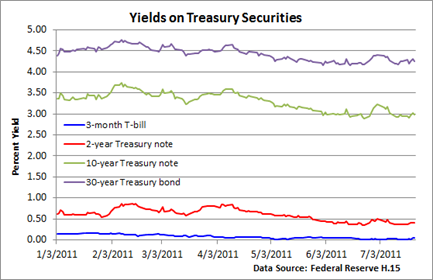
Further, measures of risk, such as the 2-year interest rate swap spread, or the difference between the yield on the two-year note and the yield on a two year swap, has been well-behaved.

All of this suggests that bond players believe the Republicans and Democrats will pass some type of increase in the debt ceiling before Treasury misses an interest payment.
AAA going the way of the dinosaur?
Of course, credit agencies have been carefully monitoring the situation and have warned that a debt ceiling increase must be accompanied by a credible plan to reduce the federal deficit.
If a more symbolic plan to reduce deficit spending is enacted, i.e., smoke and mirrors and phony cuts, the U.S. faces the real possibility of losing its coveted AAA credit rating.
And one would have to assume that both domestic and foreign investors would demand a higher premium to buy U.S. debt.
That means higher interest rates at a time when the fragile recovery does not need another impediment to growth.
The remainder of the article is available below.
With August 2 deadline for a debt deal casting a long shadow over U.S. and global equity markets, the Treasury market, which would be immediately impacted by a default, doesn’t seem to be as rattled.
Yields on T-bills over the past month have traded between 1 – 5 basis points, which realistically means you and I can park cash short-term and more or less earn what we could if we stashed it under a mattress.
And the benchmark 10-year bond is offering a yield of just about 3%, so longer-term, a domestic or foreign investors receives something for lending the government cash, but the paltry yield suggests nothing out of the ordinary looms in the foreground.

Further, measures of risk, such as the 2-year interest rate swap spread, or the difference between the yield on the two-year note and the yield on a two year swap, has been well-behaved.

All of this suggests that bond players believe the Republicans and Democrats will pass some type of increase in the debt ceiling before Treasury misses an interest payment.
AAA going the way of the dinosaur?
Of course, credit agencies have been carefully monitoring the situation and have warned that a debt ceiling increase must be accompanied by a credible plan to reduce the federal deficit.
If a more symbolic plan to reduce deficit spending is enacted, i.e., smoke and mirrors and phony cuts, the U.S. faces the real possibility of losing its coveted AAA credit rating.
And one would have to assume that both domestic and foreign investors would demand a higher premium to buy U.S. debt.
That means higher interest rates at a time when the fragile recovery does not need another impediment to growth.
Tuesday, June 21, 2011
Credit markets seem to yawn amid investor worries about Greece
The recent slide in stocks has been blamed on a slowing economy and fears that Greece will soon default on its debt, potentially causing problems in other wobbly European countries which could quickly spread to the U.S.
Credit default swaps (insurance on debt) on financials have risen (IMF), and the slowing economy and a flight to quality have pushed the yield on the ten-year Treasury below 3% and the yield on the two-year note to its lowest level on record – 38 basis points.
But a look at measures of risk in the credit markets suggest are painting a different picture – calmer waters and few fears that a jarring default might be around the corner.

The two-year interest rate swap spread on Treasuries soared during the Lehman fiasco, and once again we saw some frayed nerves when problems in Greece first surfaced a year ago.
But the latest flare-up and rating agency downgrades have caused little more than a ripple. Further, the three-month LIBOR rate is currently sitting at 25 basis points, just one tick below a record low.
Both indicators are revealing that there is ample liquidity in the financial system, and banks aren’t hoarding funds the way they did in the fall of 2008.
Credit default swaps (insurance on debt) on financials have risen (IMF), and the slowing economy and a flight to quality have pushed the yield on the ten-year Treasury below 3% and the yield on the two-year note to its lowest level on record – 38 basis points.
But a look at measures of risk in the credit markets suggest are painting a different picture – calmer waters and few fears that a jarring default might be around the corner.

The two-year interest rate swap spread on Treasuries soared during the Lehman fiasco, and once again we saw some frayed nerves when problems in Greece first surfaced a year ago.
But the latest flare-up and rating agency downgrades have caused little more than a ripple. Further, the three-month LIBOR rate is currently sitting at 25 basis points, just one tick below a record low.
Both indicators are revealing that there is ample liquidity in the financial system, and banks aren’t hoarding funds the way they did in the fall of 2008.
Wednesday, February 2, 2011
Stabilization in commercial and industrial loans signals improving economy
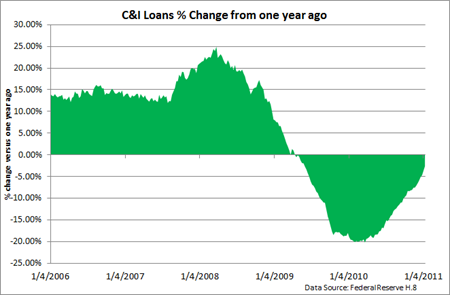
Growth in commercial and industrial loans, which took a huge hit during the recession amid falling demand for such borrowings as well as tighter credit standards, has stabilized and is beginning to edge higher.
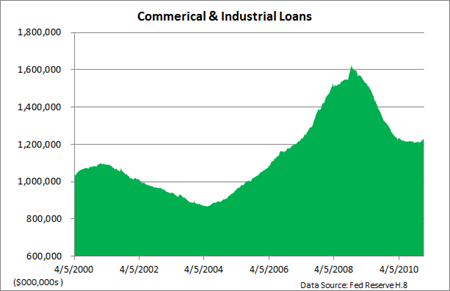
In fact, the latest Federal Reserve data showed that commercial and industrial loans grew at a seasonally adjusted annual rate of 7.6% in December, following a 0.2% annualized increase in November, the first rise since the recession ended over 18 months ago.
However, excess reserves (defined as funds that are over and above what banks are required to hold for emergency needs) once again surpassed $1 trillion according to the latest data, indicating that banks remain cautious.
In order to promote growth and encourage hiring, the Federal Reserve recently embarked on a second round of quantitative easing (QE2) and plans to purchase an additional $600 billion in longer-term Treasury securities.

Some of the extra cash may find its way into booming emerging markets and commodities, while some funds are ending up in stocks. And a portion of the proceeds appear to be ending up at the banks themselves.
But banks are flush with extra cash, and it seems that most would rather hold the excess dollars at the Fed, earning a paltry 0.25%, rather than take a chance on a riskier business loan.
Nonetheless, the frozen tundra that marked the credit markets during the worst of the recession is beginning to thaw, while sentiment is shifting, commercial loans are inching higher, and banks, if they choose, have plenty of funds on hand to fuel lending and the expansion.

In fact, the latest Federal Reserve data showed that commercial and industrial loans grew at a seasonally adjusted annual rate of 7.6% in December, following a 0.2% annualized increase in November, the first rise since the recession ended over 18 months ago.

However, excess reserves (defined as funds that are over and above what banks are required to hold for emergency needs) once again surpassed $1 trillion according to the latest data, indicating that banks remain cautious.
In order to promote growth and encourage hiring, the Federal Reserve recently embarked on a second round of quantitative easing (QE2) and plans to purchase an additional $600 billion in longer-term Treasury securities.

Some of the extra cash may find its way into booming emerging markets and commodities, while some funds are ending up in stocks. And a portion of the proceeds appear to be ending up at the banks themselves.
But banks are flush with extra cash, and it seems that most would rather hold the excess dollars at the Fed, earning a paltry 0.25%, rather than take a chance on a riskier business loan.
Nonetheless, the frozen tundra that marked the credit markets during the worst of the recession is beginning to thaw, while sentiment is shifting, commercial loans are inching higher, and banks, if they choose, have plenty of funds on hand to fuel lending and the expansion.
Monday, October 4, 2010
QE all but assured?
Much has been made that the Federal Reserve will eventually announce – probably at the November meeting – that it will once again begin expanding its balance sheet via a series of bond purchases.
Known as quantitative easing, or QE for short, the bond buys are over and above what are needed to keep short term interest rates at zero, but are necessary, proponents argue, to get the economy moving and put a “deflation firewall” in place.
The Fed announced a very modest program in August, deciding to reinvest any proceeds received from maturing mortgage-backed securities. Fed Chairman Ben Bernanke followed up with a laundry list of monetary tools the Fed still has at its disposal to support growth.
But the September 21 Fed meeting couldn’t have been clearer:
Though some at the Fed, like the Minneapolis Fed chief, have expressed concern regarding how effective new bond purchases may be, others, such as the president of the New York Fed, were more blunt in their support.
His remark last Friday that “the pursuit of the highest level of employment consistent with price stability, the current situation is wholly unsatisfactory” is a clear signal that the Fed will announce new measures on November 3, in my view.
At this point, the Fed would have to be persuaded by robust economic data NOT to pursue bolder options to boost the economy.
Unexpectedly strong employment, manufacturing or service sector data, combined with an impressive rise in Q3 GDP might persuade the Fed to hold off.
But strong GDP data in itself would not keep policy makers from acting, as an unexpected build in inventory, versus stronger consumer spending, would weigh into the equation.
I’ve harped on this before but I believe that a new round of QE would likely have little impact on the economy because excess bank reserves – funds banks can lend but have not due to tight lending standards and lack of consumer interest – already stand at $1 trillion!
Any new purchases would most likely end up increasing these excess reserves, which would end up being held at the Fed. And it could fuel a slide in the dollar and boost commodity inflation and speculative excess in emerging markets.
Falling Treasury yields
So far, the yield on the ten-year Treasury has fallen from a 2010 peak of just under 4% in April to nearly 2.4% in August, where it is currently hovering.
The debt crisis in Greece initially pressured yields, but as the crisis faded, rates continued to descend amid weak economic data and falling inflation expectations.
Speculation that the Fed might ramp up bond purchases also played a role, but it is difficult to quantify how much the drop in yields can be attributed to QE talk versus slower growth.
The Fed has total control over the fed funds rate, but its influence over longer-term rates is more limited, which limits the effectiveness of QE.
Although mortgage rates are at record lows, the housing market has struggled. Rates below 4% could provide minor support, but at this point, monetary policy has lost most of its punch, suggesting we are in or are near a liquidity trap.
With fiscal policy being held captive by a large federal deficit, time may be the only option left to fix what ails the economy.
Known as quantitative easing, or QE for short, the bond buys are over and above what are needed to keep short term interest rates at zero, but are necessary, proponents argue, to get the economy moving and put a “deflation firewall” in place.
The Fed announced a very modest program in August, deciding to reinvest any proceeds received from maturing mortgage-backed securities. Fed Chairman Ben Bernanke followed up with a laundry list of monetary tools the Fed still has at its disposal to support growth.
But the September 21 Fed meeting couldn’t have been clearer:
“The Committee will continue to monitor the economic outlook and financial developments and is prepared to provide additional accommodation if needed to support the economic recovery and to return inflation, over time, to levels consistent with its mandate.”Debate at the Fed
Though some at the Fed, like the Minneapolis Fed chief, have expressed concern regarding how effective new bond purchases may be, others, such as the president of the New York Fed, were more blunt in their support.
His remark last Friday that “the pursuit of the highest level of employment consistent with price stability, the current situation is wholly unsatisfactory” is a clear signal that the Fed will announce new measures on November 3, in my view.
At this point, the Fed would have to be persuaded by robust economic data NOT to pursue bolder options to boost the economy.
Unexpectedly strong employment, manufacturing or service sector data, combined with an impressive rise in Q3 GDP might persuade the Fed to hold off.
But strong GDP data in itself would not keep policy makers from acting, as an unexpected build in inventory, versus stronger consumer spending, would weigh into the equation.
I’ve harped on this before but I believe that a new round of QE would likely have little impact on the economy because excess bank reserves – funds banks can lend but have not due to tight lending standards and lack of consumer interest – already stand at $1 trillion!
Any new purchases would most likely end up increasing these excess reserves, which would end up being held at the Fed. And it could fuel a slide in the dollar and boost commodity inflation and speculative excess in emerging markets.
Falling Treasury yields
So far, the yield on the ten-year Treasury has fallen from a 2010 peak of just under 4% in April to nearly 2.4% in August, where it is currently hovering.
The debt crisis in Greece initially pressured yields, but as the crisis faded, rates continued to descend amid weak economic data and falling inflation expectations.
Speculation that the Fed might ramp up bond purchases also played a role, but it is difficult to quantify how much the drop in yields can be attributed to QE talk versus slower growth.
The Fed has total control over the fed funds rate, but its influence over longer-term rates is more limited, which limits the effectiveness of QE.
Although mortgage rates are at record lows, the housing market has struggled. Rates below 4% could provide minor support, but at this point, monetary policy has lost most of its punch, suggesting we are in or are near a liquidity trap.
With fiscal policy being held captive by a large federal deficit, time may be the only option left to fix what ails the economy.
Tuesday, September 28, 2010
Consumer and business lending is stagnant
Yesterday, I argued that one of the most concrete signs that uncertainty is hanging over the economy and holding back growth is the nearly $1 trillion in bank excess reserves sitting at the Federal Reserve earning next to nothing.
Today we’ll look at what’s happened to consumer credit over the last thirty years, take a quick look at commercial and industrial loans and focus on the much-talked about gamble by the Fed to keep inflation from falling below zero and boosting growth.
The nearly uninterrupted upward trend in consumer credit over the last couple of generations came to a screeching halt during the last recession. Despite an economy that began to grow last summer, consumers have shied away from taking on more debt. See chart 1.

(click chart to enlarge)
Chart 2 looks at consumer credit from a different angle, focusing in on the annualized monthly change in consumer credit.

(click chart to enlarge)
Businesses and industrial firms reacted far more negatively to what’s been going on in the economy, as chart 3 illustrates. Only in the last couple of months has lending stabilized.

(click chart to enlarge)
Consequently, the trillions the Fed has pumped into the system kept the credit markets afloat, but the funds did not work their way into the economy in the form of new lending. It ended up as excess reserves (see chart) that are being held at the Fed.
This brings us to the possibility that the Fed will implement a new plan in order to prevent a possible bout with deflation and support growth.
In the just-released Fed statement, Committee members said:
It also announced in August that it will no longer allow its balance sheet to shrink, and instead, will take the proceeds from maturing debt and purchase longer-term Treasurys.
The massive purchases may have capped longer-term yields, but it has failed to spark a robust recovery.
Another round of quantitative easing may bring down longer-term yields a bit more – the Fed’s sway over long-term interest rates is not concrete like it is over the fed funds rate – but one has to wonder how low mortgage rates have to go in order to encourage fence sitters to enter the housing market and prop up prices and sales.
Again, we are back to the premise that monetary policy has lost its effectiveness, i.e., is the Fed just pushing on a string (see Excess reserves and heightened uncertainty).
The cloud of uncertainty that’s limiting visibility needs to be blown out to sea, and only then will the stage be set for a healthy recovery.
Today we’ll look at what’s happened to consumer credit over the last thirty years, take a quick look at commercial and industrial loans and focus on the much-talked about gamble by the Fed to keep inflation from falling below zero and boosting growth.
The nearly uninterrupted upward trend in consumer credit over the last couple of generations came to a screeching halt during the last recession. Despite an economy that began to grow last summer, consumers have shied away from taking on more debt. See chart 1.

(click chart to enlarge)
Chart 2 looks at consumer credit from a different angle, focusing in on the annualized monthly change in consumer credit.

(click chart to enlarge)
Businesses and industrial firms reacted far more negatively to what’s been going on in the economy, as chart 3 illustrates. Only in the last couple of months has lending stabilized.

(click chart to enlarge)
Consequently, the trillions the Fed has pumped into the system kept the credit markets afloat, but the funds did not work their way into the economy in the form of new lending. It ended up as excess reserves (see chart) that are being held at the Fed.
This brings us to the possibility that the Fed will implement a new plan in order to prevent a possible bout with deflation and support growth.
In the just-released Fed statement, Committee members said:
“Measures of underlying inflation are currently at levels somewhat below those the Committee judges most consistent, over the longer run, with its mandate to promote maximum employment and price stability.”Members added that they will
“continue to monitor the economic outlook and financial developments and is prepared to provide additional accommodation if needed to support the economic recovery and to return inflation, over time, to levels consistent with its mandate.”Thus far the Fed has purchased $1.25 trillion of agency mortgage-backed securities, about $175 billion of agency debt and $300 billion in Treasury securities.
It also announced in August that it will no longer allow its balance sheet to shrink, and instead, will take the proceeds from maturing debt and purchase longer-term Treasurys.
The massive purchases may have capped longer-term yields, but it has failed to spark a robust recovery.
Another round of quantitative easing may bring down longer-term yields a bit more – the Fed’s sway over long-term interest rates is not concrete like it is over the fed funds rate – but one has to wonder how low mortgage rates have to go in order to encourage fence sitters to enter the housing market and prop up prices and sales.
Again, we are back to the premise that monetary policy has lost its effectiveness, i.e., is the Fed just pushing on a string (see Excess reserves and heightened uncertainty).
The cloud of uncertainty that’s limiting visibility needs to be blown out to sea, and only then will the stage be set for a healthy recovery.
Thursday, August 26, 2010
Mortgage rates hit another low
Mortgage rates continue to descend and are sitting at another low this week, according latest survey from Freddie Mac.
Freddie Mac’s weekly survey revealed that the key lending rate for home loans slipped from 4.42% last week to 4.36% in the latest week, inclusive of 0.7 points. The 15-year FRM averaged a record low of 3.86% with an average 0.6 point, down from last week when it averaged 3.90%.
The survey of 30-year mortgages began in 1971, while Freddie Mac began tracking the 15-year fixed rate in 1991.

The slowdown in the economy, diminishing inflation expectations and a general belief that the Federal Reserve will take more aggressive actions to ease the economic slowdown have leaned on the yield for the 10-year Treasury note, which heavily influences rates quoted for 30-year mortgages.
Those able to refinance their current loans have started to take advantage of the bonanza that is currently being offered.
Despite the jump in affordability, record low mortgage rates have done little to support housing in recent weeks, as the hangover from the expiration of the tax credit and a difficult economy have blunted the tailwind from low rates (see Housing market hits the wall…No putting lipstick on this pig).
Wednesday, May 26, 2010
TED spread has been moving higher
Reaction to Europe showing up in key measure of risk
Yesterday, I took a look at the 3-month LIBOR rate and discussed how the recent increased has been tied to tension in the credit markets flowing from southern Europe.
Today, I want to take some time and discuss another gauge that measures risk in the credit markets – the TED spread. The TED spread looks at the difference between the 3-month LIBOR and the 3-month U.S. T-bill.
The 3-month T-bill is considered a risk-free rate of return because the investment is short-term and is backed by the full faith and credit of the U.S. government.
When credit markets are functioning normally, we are likely to see a very narrow spread because there is very little risk for banks to park excess reserves in either a T-bill or lend it to another bank for 90 days.
Think back to the 1990s or the mid part of the last decade. Lending funds short term to a large U.S. or European bank is an easy way to earn a little extra cash over a T-bill with a virtual guarantee of the return of principal. But in theory, it’s not quite risk free; hence, the slightly higher interest rate.

TED spread
But the sovereign debt crisis in Europe has caused an increases in skittishness among banks, who fear that a default by Greece could quickly lead to write downs at major European banks and possibly threaten the solvency of some institutions.
Therefore, funds available among banks has fallen, leading to a rise in the 3-month LIBOR rate.
Thus far, the increase in the TED spread is a reflection of what is happening in Europe, and the modest impact on credit markets is not enough to harm economic activity, in my view.
And the rise pales in comparison to what happen in the wake of the Lehman crisis, when an already elevated level between 85-100 soared to over 460, indicating credit markets were nearly frozen and the financial system was near the breaking point.
America holds very little paper from Greece, but Spain, which has been in the spotlight lately, owes U.S. institutions almost $200 billion, according to the New York Times, highlighting how interconnected countries around the world are.
The TED spread did fall slightly today, but the key measure of risk is worth watching, as it provides a good reading or temperature of the financial markets.
Tuesday, May 25, 2010
Credit markets tighten as European debt fears spread
LIBOR on upward trajectory
Stocks in the U.S. turned decidedly lower at the opening but managed to rally through the day to finish almost unchanged, but credit markets continue to slowly tighten as fears grow that the fiscal woes engulfing Greece could spread to other countries and banks in Europe.
The 3-month LIBOR rate rose nearly 3 basis points (bp) to 54 bp today, the highest since July 2009 and more than double the rate seen from early December through mid-March, which preceded the problems that forced the EU to craft a huge bailout of Greece.
LIBOR is the London Interbank Offered Rate which banks can borrow unsecured funds from other banks. Typically, the rate will hold steady when there are few if any expectations that the Fed is set to adjust interest rates. The rate can and does drift higher when most analysts and traders expect a rate hike, while forecasts of rate cut will weigh on LIBOR.
Currently, creaks in the financial system have caused a reluctance among those banks with excess funds to lend out to banks their surplus amid concerns that problems down the road could delay or prevent repayment. Another words, the dwindling supply of cash to lend, without a corresponding dip in demand, is causing rates to rise.
So far, the credit markets have been adapting to the problems overseas, but the rise in LIBOR could put upward pressure on adjustable rates when they reset as well as put upward pressure on consumer loan rates at a time when the recovery is still in its early stages.
But the gradual increase is also a reflection of growing tensions in the global financial system, even with the massive bailout package that was announced earlier in the month.
The steady but slow rise suggests governments have been able to temporarily address crisis in southern Europe, but major changes in fiscal policy, which may be difficult to implement, are a key part of the solution.
Stocks in the U.S. turned decidedly lower at the opening but managed to rally through the day to finish almost unchanged, but credit markets continue to slowly tighten as fears grow that the fiscal woes engulfing Greece could spread to other countries and banks in Europe.
The 3-month LIBOR rate rose nearly 3 basis points (bp) to 54 bp today, the highest since July 2009 and more than double the rate seen from early December through mid-March, which preceded the problems that forced the EU to craft a huge bailout of Greece.
LIBOR is the London Interbank Offered Rate which banks can borrow unsecured funds from other banks. Typically, the rate will hold steady when there are few if any expectations that the Fed is set to adjust interest rates. The rate can and does drift higher when most analysts and traders expect a rate hike, while forecasts of rate cut will weigh on LIBOR.
Currently, creaks in the financial system have caused a reluctance among those banks with excess funds to lend out to banks their surplus amid concerns that problems down the road could delay or prevent repayment. Another words, the dwindling supply of cash to lend, without a corresponding dip in demand, is causing rates to rise.
So far, the credit markets have been adapting to the problems overseas, but the rise in LIBOR could put upward pressure on adjustable rates when they reset as well as put upward pressure on consumer loan rates at a time when the recovery is still in its early stages.
But the gradual increase is also a reflection of growing tensions in the global financial system, even with the massive bailout package that was announced earlier in the month.
The steady but slow rise suggests governments have been able to temporarily address crisis in southern Europe, but major changes in fiscal policy, which may be difficult to implement, are a key part of the solution.
Thursday, May 6, 2010
U.S. measures of risk rising
But not yet worrisome
The three charts below are key measure of risk in the financial system and measure how will large banks and institutions are to lend to each other.
Risk is slowly creeping back into the banking system, as fear grows the Greece’s fiscal crisis may spread to Portugal, Spain and beyond. We’re nowhere near the numbers seen post-Lehman crisis, but the uptick definitely bears monitoring.
In Europe, it’s a different matter, with counterparty risk rising dramatically on worries that debt writedowns could have a major impact on individual bank balance sheets.
Fears about the future of the euro have taken a big toll over the past week.
 TED spread
 3-month LIBOR

The three charts below are key measure of risk in the financial system and measure how will large banks and institutions are to lend to each other.
Risk is slowly creeping back into the banking system, as fear grows the Greece’s fiscal crisis may spread to Portugal, Spain and beyond. We’re nowhere near the numbers seen post-Lehman crisis, but the uptick definitely bears monitoring.
In Europe, it’s a different matter, with counterparty risk rising dramatically on worries that debt writedowns could have a major impact on individual bank balance sheets.
Fears about the future of the euro have taken a big toll over the past week.
 TED spread
 3-month LIBOR
2-year U.S. dollar swap spread
All charts offered from Bloomberg.
Wednesday, May 5, 2010
Europe's debt problems and LIBOR
Back in the fall of 2008, credit spreads soared as investors rushed out of riskier assets and plunged into the safety of Treasuries. While we are seeing spreads widen considerably in Europe - the yield on Greek bonds has soared compared to bonds issued by Germany, changes in spreads have been mild in the U.S.
Nonetheless, the 3-month LIBOR rate has started to tick higher. After bottoming and about 25 basis points, the rate has inched up over the past six weeks or so to 36 basis points.
That's not anything to be alarmed about at this point. Still, the upward drift bears watching.
Nonetheless, the 3-month LIBOR rate has started to tick higher. After bottoming and about 25 basis points, the rate has inched up over the past six weeks or so to 36 basis points.
That's not anything to be alarmed about at this point. Still, the upward drift bears watching.
Monday, July 13, 2009
Mortgage rates and a roller coaster
Mortgage rates surged at the end of May, leaving many who had been hoping to snag the deal of a lifetime for a refi or a new home home bewildered.
Then rates suddenly moved lower. At Examiner.com, I look into factors that are likely to impact mortgage rates in the near term in my article, Are mortgage rates headed back below 5%.

Friday, June 12, 2009
The latest on mortgage rates
It’s not pretty. Mortgage rates have jumped in recent weeks, cooling the refi boom and putting Ben Bernanke’s plan to reignite the housing market in danger. Blame the rise in the yield on the ten-year Treasury bond.

A more detailed look at the how and why of mortgage rates is available in my post, What is behind the recent rise in mortgage rates, at Examiner.com.
Wednesday, June 10, 2009
Ten-year Treasury yield just under 4%
The government announced the sale of $19 billion in ten-year Treasury bonds today at a rate of 3.99%, while Russia's central bank is reportedly considering a modest move away from holding its reserves in dollars.
As a result bond prices continued on their downward path and yields pushed ever higher, which threatens to stifle the housing market that has been scraping along at very low levels. See Rising Mortgage Rates May Add to Housing Woes.
I've mentioned before how Fed Chief Ben Bernanke has committed over $1 trillion to buy agency-backed securities and another $300 billion in longer-term Treasuries in order to squeeze the risk premium out of the system - that is, narrow the spread between US Treasuries and lending among major financial institutions and thereby lowering borrowing costs.
His plan did temporarily bring down yields on government bonds and spreads have narrowed. See see Credit markets on the mend. But the so-called "bond vigilantes" are in open revolt over the massive federal budget deficit and future worries about inflation. And the spike in yields is playing havoc with homeowners who had planned to refinance mortgages, and it could keep some potential home buyers on the sidelines. See Higher Mortgage Rates Dampen Refi Enthusiasm.
As a result bond prices continued on their downward path and yields pushed ever higher, which threatens to stifle the housing market that has been scraping along at very low levels. See Rising Mortgage Rates May Add to Housing Woes.
I've mentioned before how Fed Chief Ben Bernanke has committed over $1 trillion to buy agency-backed securities and another $300 billion in longer-term Treasuries in order to squeeze the risk premium out of the system - that is, narrow the spread between US Treasuries and lending among major financial institutions and thereby lowering borrowing costs.
His plan did temporarily bring down yields on government bonds and spreads have narrowed. See see Credit markets on the mend. But the so-called "bond vigilantes" are in open revolt over the massive federal budget deficit and future worries about inflation. And the spike in yields is playing havoc with homeowners who had planned to refinance mortgages, and it could keep some potential home buyers on the sidelines. See Higher Mortgage Rates Dampen Refi Enthusiasm.
Monday, June 8, 2009
Credit markets on the mend
The latest piece of evidence to show that credit conditions are on the mend came in this piece by Bloomberg News entitled, ‘Fierce Rally’ Under Way for Loan CDOs, Morgan Stanley Says.
The article states,
“CLOs are a type of collateralized debt obligation that pool high-yield, high-risk, or junk, loans and slice them into securities of varying risk and return. Pieces graded AA, the third highest-level of investment grade, rose from 23 cents on the dollar to 47 cents in the past month.” Bloomberg cited a report by Morgan Stanley.
The three-month LIBOR rate has fallen dramatically, and the TED spread (chart below) and the Libor-OIS spread (both measures of risk), have narrowed considerably. See Credit Markets are Finally Melting.
The three month LIBOR defines the rate banks lend to each other for three months, while the TED spread is the difference between LIBOR and the three-month T-bill. OIS (Overnight Index Swaps) are a little bit more complex but I located a great definition for those looking for the details at Learning Markets.
How does this measure risk?
The re-emergence in risk-taking is not only a clear indication that confidence is returning to the credit markets, but an signal that a Lehman style debacle or AIG bailout isn’t going to happen again.
Last September, Fannie Mae and Freddie Mac were nationalized, AIG was bailed out, and Lehman was allowed to disintegrate. Fear in the credit markets grew exponentially and a flight-to-quality ensued, driving T-bill yields to zero.
Even the normally safe three-month Eurodollar contracts, which are priced by the three-month LIBOR, were dumped as inter-bank lending ground to a halt. Funds sought all but the safest assets, such as US Treasuries, sending spreads into the stratosphere.
As the atmosphere has returned to a sense of normalcy and most traders no longer anticipate a failure of a major institution, spreads are narrowing and lending among banks is returning.
Rate hike in the near term?
The improvement in financial markets is likely to underpin economic activity. In fact, fed funds future are now pricing in a modest chance of a rate increase later this year.
In my view, we need to see an improvement in employment and positive growth in the US before the Fed will start raising rates. Bernanke and Co. do not want to be accused of short-circuiting an economic recovery by stepping on the brakes too soon.
Thursday, May 28, 2009
Treasuries stabilize
I have been spending quite a bit of time on Treasury bonds lately because of the importance the yield has to the economy.
Earlier today, prices bounced back and yields fell as buyers stepped in to take advantage of more attractive rates. Yesterday, Moody's reassured nervous investors that the triple-A rating the US enjoys is safe, at least for now, aiding the benchmark security.
But sellers have stepped and the ten-year note is holding slightly above the unchanged mark. The story remains little changed: the extraordinarily high level of supply needed to finance a burgeoning budget deficit is scaring away investors.
Consequently, mortgage rates, which are tied closely to the ten-year bond, have jumped in recent days.
Separately, a look at jobless claims, durable goods orders, and new home sales can be seen on my homepage at Examiner.com.
Earlier today, prices bounced back and yields fell as buyers stepped in to take advantage of more attractive rates. Yesterday, Moody's reassured nervous investors that the triple-A rating the US enjoys is safe, at least for now, aiding the benchmark security.
But sellers have stepped and the ten-year note is holding slightly above the unchanged mark. The story remains little changed: the extraordinarily high level of supply needed to finance a burgeoning budget deficit is scaring away investors.
Consequently, mortgage rates, which are tied closely to the ten-year bond, have jumped in recent days.
Separately, a look at jobless claims, durable goods orders, and new home sales can be seen on my homepage at Examiner.com.
Wednesday, May 27, 2009
Bailing out of bonds
The yield on the benchmark US Treasury note jumped 19 basis points (0.19%) to 3.73% today, causing the difference between the yield on the two- and ten-year notes to rise to the highest ever.

Everything from concerns about the ability of the US to maintain its triple-A credit rating to the huge supply of debt that must be sold to finance the growing federal deficit to the Fed's eventual pullout from the Treasury market are forcing up yields.
But the jump is presenting the Fed with a big problem. Typically, a widening yield curve - defined as the difference in yields for differing maturities of the same debt instrument - is a sign that better economic times lie ahead.
But rising yields are pushing up mortgage rates at a time when monetary officials want to keep rates low in order to support housing activity. The last thing Bernanke (or any of us) wants to see is his green shoots being singed by the heat of high mortgage rates.
I saw one major institutions offering a 30-year fixed rate at 5.75% today. That may force a few potential buyers off the fence, but it could keep many more on the sidelines.
Everything from concerns about the ability of the US to maintain its triple-A credit rating to the huge supply of debt that must be sold to finance the growing federal deficit to the Fed's eventual pullout from the Treasury market are forcing up yields.
But the jump is presenting the Fed with a big problem. Typically, a widening yield curve - defined as the difference in yields for differing maturities of the same debt instrument - is a sign that better economic times lie ahead.
But rising yields are pushing up mortgage rates at a time when monetary officials want to keep rates low in order to support housing activity. The last thing Bernanke (or any of us) wants to see is his green shoots being singed by the heat of high mortgage rates.
I saw one major institutions offering a 30-year fixed rate at 5.75% today. That may force a few potential buyers off the fence, but it could keep many more on the sidelines.
Subscribe to:
Posts (Atom)


