Thursday, June 30, 2011

Jobless claims hold in narrow path

Weekly jobless claims fell 1,000 in the latest week to 428,000 and have now held in a very narrow range – 420,000 to 430,000 for six consecutive weeks. As a result, the 4-week moving average barely moved, rising by just 500 to 426,750.

image

The lack of any significant upward are downward movement in jobless claims, following a brief dip earlier in the year below 400,000, is telling us that the economy continues to slowly improve.

Based on the release as well as recent trends, no new recession is on the horizon but any pick up in economic growth is unlikely, either.

Simply put jobless claims are still elevated, underscoring the uncertainty many of us feel regarding what’s happening in the economy.

Despite the lack of any signs of an acceleration in economic activity, the Chicago Purchasing Managers Index, which looks at manufacturing activity in the Midwest, unexpectedly rose in the latest month.

image

A possible pick up in auto production tied to an easing of the supply chain disruption from Japan that followed the tragic earthquake that hit the nation earlier in the year might explain the welcome rise in the index.

Both production and new orders surged, while inventories tumbled.  Unfortunately, prices paid eased slightly but remained at a worrisome level, which is somewhat surprising given the recent fall in commodity prices.

Nonetheless, the Chicago PMI tends to be a rather volatile index, and other measures of regional manufacturing have slowed significantly.

We’ll get a better read when the ISM Manufacturing Index is released on Friday.

Wednesday, June 29, 2011

Slower growth pressures consumer confidence

Sometimes just waiting a day or so to let a particular release marinate allows us to gain a bit of perspective. Fed releases and unemployment data come to mind.

But I wouldn’t preclude a day-late look at the Conference Board’s survey of consumer confidence either.

image

The Consumer Confidence Index fell 3.2 points in the latest month, which makes the dip in June the third decline in four months. Clearly, not a trend that is welcome by Fed officials and investors.

The economic data are still pointing to a growing economy, but the heightened level of uncertainty that has been clouding the outlook has been taking a toll on sentiment in recent months.

Job creation slowed considerably in May, jobless claims are up, manufacturing activity has moderated, the housing market remains in the doldrums and many refuse to throw caution to the wind whenever they go online or shop at their local retailer.

Of course, gasoline prices are well off the early May highs, but at over $3.50 per gallon in most locales, a fill up still takes a considerable bite out of our wallets.

Until economic activity re-accelerates – and it still appears that the latest economic bump in the road will be short-lived – consumer confidence will probably remain under pressure, and caution will prevail at the nation’s malls.

Monday, June 27, 2011

Consumer spending hits a bump in the road

The government reported this morning that consumer spending was unchanged in May, highlighting the slowdown in job growth and the uncertainty in consumer sentiment.

Personal income managed to rise 0.3% and the savings rate increased a tick to 5.0%.

Removing the impact of inflation, real consumer spending actually declined by 0.1%, the same as April. 

Moving over to inflation, the PCE Price Index was up 0.2% last month, but the core rate, which excludes food and energy, rose by 0.3%, signaling that the steep jump in commodity prices is slowly beginning to leak into goods and services.

Summarizing the data-heavy, number’s-heavy report simply confirms what we’ve already known – growth has slowed but has not stalled.

Thursday, June 23, 2011

IEA oil release hammers prices– at least in the short term

The surprise announcement today by the International Energy Agency (IEA) that its member countries – 28 in all – will release 60 million barrels of oil from storage over the next 30 days took a heavy toll on prices, knocking the cost of crude briefly below $90 per barrel.

That’s good news for consumers – at least short term as the IEA’s press release appears to have had its intended effect.

But all is not OK in the world oil markets.

First, the move almost smacks of desperation, as the world economy slows under the pressure of weak U.S. growth, debt worries in Greece and a modest slowdown in China.

An interesting and unsettling side note: stocks did not react favorably to the drop in crude prices, and instead continued to a sell-off that was tied to Bernanke’s sobering economic remarks made yesterday afternoon.

Second, the unrest in Libya has taken about 132 million barrels of light, sweet crude off the market up through the end of May per the IEA.

And despite talk by Saudi Arabia that it would make up the difference, the announcement suggests otherwise.

But the temporary increase in oil production is just that – temporary, and it’s possible that a further downward slide in prices could be met by a quiet cutback in OPEC or Saudi production.

Moreover, the US market is well supplied with crude at the present time, as the chart from the EIA reflects.

image

Consequently, the pullback in prices may turn into a more temporary phenomenon.

Additional supply disruptions or still weaker economic growth will very likely have more of an impact on prices down the road than today’s news.

New homes for sale at record low

The number of new homes for sale on the market slipped to a record low in the latest month, according to data supplied by the Commerce Department.

The actual number of new homes on the market fell from 172,000 in April to 166,000 in May, the lowest number since the government began tracking new home sales in 1963.

image

But sales have been in the basement, and 166,000 actual homes for sales represents a 6.2 months supply. That’s well below the January 2009 high of 12.2 months but in line with the average over the past 40+ years of 6.2 months.

Further, the 166,000 figure is not adjusted for the much larger population we have today versus the 1960s!

But it’s clear that all is not sound with the new housing market.  Builder confidence remains very low, explaining the lack of production and apparently tight inventory of new houses.

And competition from distressed sales of late model homes and the shadow inventory that remains over the market are offsetting any tailwinds that might assist new builders.

image

Still, falling supplies seem likely to set the stage for an eventual recovery in the new home market.

In the meantime, sales of new homes fell 2.1% to an annual pace of 319,000 in May.

Sales aren’t showing any signs of recovering and instead, or holding near the bottom.

Weekly jobless claims camp out on a plateau

Bloomberg News cited “technical issues” that forced the Labor Department to estimate claims in six states as a possible reason  for a troublesome 9,000 increase in weekly initial jobless claims to 429,000 in the latest week.

image

The 4-week moving average held steady at 426,250, and continuing claims were practically unchanged at 3.7 million.

Nonetheless, weekly jobless claims are holding well above 400,000 following a brief dip below the key psychological level.  And the elevated level highlights the uncertainty in the economy and the reduced pace of the recovery.

Wednesday, June 22, 2011

Fed cuts forecast on GDP, as Bernanke comments pressure stocks

"You're on your own"

There weren’t any big surprises to come out of the Fed’s press release that followed the conclusion of its two-day meeting.

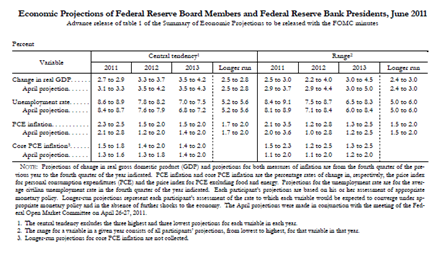
The FOMC acknowledged the slowdown in the economy, telegraphed that interest rates aren’t going higher anytime soon, will no longer expand its balance sheet and believes the growth will eventually accelerate. A cut and dry look is available at Examiner.
image
(Source: Fed)

Further, the Fed also cut its forecast on GDP growth for the second time this year.  Unfortunately, the FOMC expects unemployment to remain uncomfortable high through the end of 2013.

image
(Source: Fed)

What did seem to catch the markets off guard occurred in the press conference that followed the FOMC meeting.

The Fed noted in its press release, “The slower pace of the recovery reflects in part factors that are likely to be temporary, including the damping effect of higher food and energy prices on consumer purchasing power and spending as well as supply chain disruptions associated with the tragic events in Japan.”

'In part' implies there were other factors impacting the economy and an astute reporter quickly picked up on this, asking what else might be responsible for the sluggish recovery.

Bernanke responded that monetary officials don’t have a precise read as to why slower pace is persisting. But some of the headwinds that are of concern included “weakness in the financial sector, problems in the housing sector, balance sheet and deleveraging issues.”

He added that some of these headwinds may be stronger and more persistent than “we thought.”

Of course, questions about Europe and Greece surfaced and the potential impact on the U.S.

Bernanke said the Fed has been “very assiduous” in examining the exposures financial institutions have countries that have been plagued by debt issues.

U.S. banks are not significantly exposed to those countries, including Greece, as direct exposure is “pretty small.” Exposure is larger in the more stable countries, such as Germany and France.

The same holds true with money market funds. Exposure is minor in peripheral countries but there is substantial exposure in European banks in so-called core countries, Germany, France etc.

Not surprisingly, Bernanke said a disorderly default would “no doubt roil financial markets globally would have a big impact on credit spreads (thus far, its been minor), stock prices and so on. Effects in US would be quite significant.”

It’s the disorderly default the Fed is hoping to prevent.

Bernanke to economy: You're on your own
Well, Bernanke didn't utter those words, but one has to ask, "What has the Fed chairman done?"

Bernanke took credit for eliminating the small but growing threat of deflation that was emerging last summer and noted that job creation picked up amid the QE2 bond purchases.

Other than that, the Fed chairman seemed more like a deer in the headlights, conceding that growth is slowing and some of the causes may be more than temporary.

He offered little solace to those of have been heavily impacted by job losses or those who've yet to see stock and retirement portfolios fully recovery from the 2008-09 bear market.

In other words, monetary policy has its limits.