Showing posts with label FOMC decision. Show all posts

Thursday, September 13, 2012

The Fed–shoot now, ask questions later

The markets had anticipated the Fed would act, but the magnitude of the FOMC’s open-ended commitment to increase its balance sheet was met with a bullish stampede today.

And it wasn’t just stocks. Oil, gold and a host of other commodities gained ground.

The Fed is trying to reflate, and it won’t stop until it sees substantial progress in the labor market. In fact, the Fed’s statement was clear:
“If the outlook for the labor market does not improve substantially, the Committee will continue its purchases of agency mortgage-backed securities, undertake additional asset purchases, and employ its other policy tools as appropriate until such improvement is achieved in a context of price stability.”
So it's not just looking for improvement. The Fed will continue its bond purchases until it sees "substantial improvement."

At least publicly, it does not believe it will materially add to inflation, but the key question is whether its latest path will aid the economy and move the needle on the unemployment rate.

QE1 and QE2 - or $2.3 trillion in bond buys - have failed to significantly lift the economy. Bernanke even acknowledged in his press conference that "I don't think our tools are that strong."

The Fed chief has said before that monetary policy is not a panacea, but that was an interesting remark as the central bank embarks on a new chapter.

Tuesday, March 13, 2012

Fed statement–little change

A very quick and cursory look at the just-released Fed statement - 2:15 pm ET - revealed mostly a carbon copy of January's statement. And maybe just a slight upgrade in the outlook.

The Fed said:
  • the economy is expanding moderately and it expects moderate economic growth over the coming quarters.
  • the unemployment rate has declined notably but going forward, it anticipates just a gradual drop
  • higher oil and gasoline will have just a temporary impact on inflation before it eventually slows (added)
    • With the economy still on an uneven footing, would the majority on the Fed really acknowledge a concern about inflation? Seems unlikely as that would force their hand and it would send LT rates soaring.
  • no changes in any language regarding a third round of QE
None of this is really any surprise.

The Fed may just be setting the stage for something more significant at its two-day meeting in April (March's was just a day).

Final demand, which has befuddled policymakers given the relatively upbeat nonfarm payroll numbers, may hold the key for any new round of easing.

Sterilized bond buys appears to be the most likely part if we have a new move.

Retail sales
Good news on the retail front this a.m., and the upward revisions to January were welcome. But taken together with the weakness in Nov and Dec, it's steady as she goes. Still, I'll take upbeat numbers at the margin any day.

All this suggests the consumer is feeling better moving into the new year, as higher consumer confidence translates into more spending, despite the surge in gasoline prices.

Thursday, January 26, 2012

Fed opens door wider to QE3

We're not there yet but comments coming out of yesterday's Fed meeting strongly suggested that the Fed will eventually implement a new round of QE3.

None of this should come as a surprise since a majority of Fed voting members have been bemoaning the high rate of unemployment for a while.

Sure we've seen a modest pick up in growth since the summer, but progress on unemployment has been slow, and publicly, that is the Fed's reason for its focus on QE3.

Economic projections are far from rosy
  1. Sluggish GDP growth. In fact, a slight dip in the GDP forecast from Nov.
  2. Slow progress on unemployment.
  3. Subdued inflation within the Fed’s target.

In Bernanke's opening statement of his press conference, he said the Fed is "prepared to provide further monetary accommodation if employment is not making sufficient progress towards our assessment of its maximum level, or if inflation shows signs of moving further below its mandate-consistent rate.”

So if inflation slips some, the Fed has the extra wiggle room to buy bonds. Helicopter Ben couldn't pass up that opportunity!

And he added in a follow up to a question that QE3 is an “an option that’s certainly on the table.”

Tuesday, July 12, 2011

FOMC minutes reveal members discussed the ‘how to’ but not when for an exit strategy

The June 21-22, 2011 meeting of the FOMC – Federal Open Market Committee – met against the backdrop of slowing economic activity, a pick up in core inflation, which it still believes is temporary, and growing fears that one or more countries in Europe might default on their debt.

The FOMC minutes noted that growth in consumer spending has declined, the labor market has softened, and activity in the housing market remains depressed.

Exit stage left
At the conclusion of the meeting, the FOMC decided that when the time comes to begin normalizing policy, it plans to:
  1. Stop reinvesting some or all principal repayments
  2. Modify its forward guidance on the path of the fed funds rate and initiate temporary reserve-draining operations aimed at supporting the implementation of increases in the fed funds rate when appropriate
  3. When conditions warrant, begin raising the target for the fed funds rate
  4. Sale of agency securities likely to begin sometime after the first hike in the fed funds rate, with timing and pace communicated to the public in advance
  5. Once sales begin, the pace of sales is expected to be aimed at eliminating the holdings of agency securities over a period of three to five years
  6. And finally the FOMC stands ready to adjust its exit strategy depending on economic and financial conditions.
The template provides the investing public with guidelines, but there was not indication as to when such an undertaking might begin.

Currently, the Fed is battling a slowdown in economic activity and an acceleration in core inflation.

Further increases in inflation would greatly complicate the Fed’s job of promoting its statutory mandate of maximum employment and price stability.

Commodity prices have jumped, which is fueling the rise in inflation, but wage gains have been stagnant, and excess capacity and subdued demand suggest any further and unwanted gains in inflation are probably not on the horizon.

Additionally, the Committee pointed out that longer-run inflation expectations remain stable.

Most participants expected that much of the rise in headline inflation this year would prove transitory, and inflation over the medium term would be subdued as long as commodity prices did not continue to rise rapidly and longer-term inflation expectations remained stable.

Nevertheless, a number of participants judged the risks to the outlook for inflation as tilted to the upside. Moreover, a few participants saw a continuation of the current stance of monetary policy as posing some upside risk to inflation expectations and actual inflation over time.

But Committee members were divided on what to do.

On the one hand, a few members noted that, depending on how economic conditions evolve, the Committee might have to consider providing additional monetary policy stimulus, especially if economic growth remained too slow to meaningfully reduce the unemployment rate in the medium run. QE3?

But a few members viewed the increase in inflation risks as suggesting that economic conditions might well evolve in a way that would warrant the Committee taking steps to begin removing policy accommodation sooner than currently anticipated.

Consequently, the Fed stayed on its expected path, signaling it will hold the fed funds rate at the current level for an extended period and concluded the meeting by stating it will end its planned purchases of $600 billion in Treasuries by the end of June.

Wednesday, June 22, 2011

Fed cuts forecast on GDP, as Bernanke comments pressure stocks

"You're on your own"

There weren’t any big surprises to come out of the Fed’s press release that followed the conclusion of its two-day meeting.

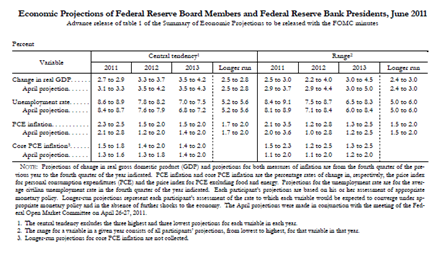
The FOMC acknowledged the slowdown in the economy, telegraphed that interest rates aren’t going higher anytime soon, will no longer expand its balance sheet and believes the growth will eventually accelerate. A cut and dry look is available at Examiner.
image
(Source: Fed)

Further, the Fed also cut its forecast on GDP growth for the second time this year.  Unfortunately, the FOMC expects unemployment to remain uncomfortable high through the end of 2013.

image
(Source: Fed)

What did seem to catch the markets off guard occurred in the press conference that followed the FOMC meeting.

The Fed noted in its press release, “The slower pace of the recovery reflects in part factors that are likely to be temporary, including the damping effect of higher food and energy prices on consumer purchasing power and spending as well as supply chain disruptions associated with the tragic events in Japan.”

'In part' implies there were other factors impacting the economy and an astute reporter quickly picked up on this, asking what else might be responsible for the sluggish recovery.

Bernanke responded that monetary officials don’t have a precise read as to why slower pace is persisting. But some of the headwinds that are of concern included “weakness in the financial sector, problems in the housing sector, balance sheet and deleveraging issues.”

He added that some of these headwinds may be stronger and more persistent than “we thought.”

Of course, questions about Europe and Greece surfaced and the potential impact on the U.S.

Bernanke said the Fed has been “very assiduous” in examining the exposures financial institutions have countries that have been plagued by debt issues.

U.S. banks are not significantly exposed to those countries, including Greece, as direct exposure is “pretty small.” Exposure is larger in the more stable countries, such as Germany and France.

The same holds true with money market funds. Exposure is minor in peripheral countries but there is substantial exposure in European banks in so-called core countries, Germany, France etc.

Not surprisingly, Bernanke said a disorderly default would “no doubt roil financial markets globally would have a big impact on credit spreads (thus far, its been minor), stock prices and so on. Effects in US would be quite significant.”

It’s the disorderly default the Fed is hoping to prevent.

Bernanke to economy: You're on your own
Well, Bernanke didn't utter those words, but one has to ask, "What has the Fed chairman done?"

Bernanke took credit for eliminating the small but growing threat of deflation that was emerging last summer and noted that job creation picked up amid the QE2 bond purchases.

Other than that, the Fed chairman seemed more like a deer in the headlights, conceding that growth is slowing and some of the causes may be more than temporary.

He offered little solace to those of have been heavily impacted by job losses or those who've yet to see stock and retirement portfolios fully recovery from the 2008-09 bear market.

In other words, monetary policy has its limits.

Wednesday, April 27, 2011

Fed still transitory on spike in inflation

The Fed was pretty clear where it stands on the recent spike in inflation from extremely low levels.

In its statement, the FOMC said: “Commodity prices have risen significantly since last summer, and concerns about global supplies of crude oil have contributed to a further increase in oil prices since the Committee met in March.  Inflation has picked up in recent months (a new addition to the statement), but longer-term inflation expectations have remained stable and measures of underlying inflation are still subdued.

The Fed added, “Increases in the prices of energy and other commodities have pushed up inflation in recent months.  The Committee expects these effects to be transitory.”

It’s the publicly stated belief that higher gasoline and other commodity prices won’t stoke a new round of unwanted inflation which pushed the dollar down and gold and silver prices higher in late afternoon action.

Traders believe that Bernanke is not taking a hard enough line on surging commodity prices.

But wage gains remain stable and there’s still some slack in the economy, and that does give the Fed some leeway.

Moreover, Bernanke’s focus is on the tepid pace of the economic recovery, and a hawkish shift in the Fed’s stance is unlikely as long as unemployment remains high and job creation does not substantially accelerate.

Given a ten-year Treasury yield that is below 3.40%, the bond market is more in sync with the Fed, even if gold and the dollar are not.

Still, there are always risks to the outlook, and Bernanke is willing to gamble on an uptick in the core rate of inflation if it means a more robust recovery.

Fed boosts inflation forecast, cuts GDP

Bernanke points to end of QE

The first take on the Fed’s rate decision and economic outlook is available in my piece, Fed holds steady, tweaks outlook on economy. But in conjunction with Ben Bernanke’s first press conference, the Fed released its outlook on the economy, lifting its view on inflation and cutting the outlook on GDP growth.

Below is a look at economic projections released today by the Federal Reserve for GDP, unemployment, headline inflation and core inflation.

image
 (click to enlarge)

Despite its latest take on inflation, the Fed still believes the impact on inflation will be “transitory,” as wages, the biggest input cost to most businesses, have been stable, and there is still some slack in the economy.

Q&A
QE2 - no tapering off; the Fed will just let the program end in June, and he doesn’t expect much of a disruption in the financial markets since the central bank’s intentions have been well telegraphed.

Because inflation has picked up somewhat and inflation expectations are a little higher, trade-offs for a third round of quantitative easing are less attractive at this point. Translation: QE3 looks unlikely amid the spike in gasoline prices.

Other sound bites from Bernanke in his press conference:

His interpretation of “extended period” in the statement goes out two meetings, but it is also used simply because uncertainty is a part of every economic equation.

The Fed cut its GDP forecast based on an expected weak Q1 GDP number, which it also believes will be transitory.

The Fed is carefully watching gasoline prices, but rising oil demand has been mostly confined to emerging markets and U.S. demand is down. Consequently, the Fed has little control over the price of oil.

Bernanke supports a stable dollar, and the recent decline is mostly due to an unwinding of safe-haven buys. Still, he didn't talk much on the importance of a strong dollar, suggesting that a stable and strong dollar is not high on the Fed's list of priorities.

Looking ahead, the Fed plans to maintain the level of securities on its balance sheet and re-invest maturing securities, something I alluded to yesterday when I previewed today’s report.

Bernanke said that not re-investing the proceeds of maturing securities would shrink the Fed’s balance sheet and would be correctly construed as tightening.

Asked whether the Fed's monetary policy might provide the future tinder for inflation, Bernanke believes the Fed will tighten at the right time and not stoke unwanted inflationary pressures by easing for too long a period.

On the deficit, Bernanke said addressing the spending and revenue gap must be a top priority.

Asked if the public is expecting too much from the Fed given that recessions sparked by a financial crisis are slow, Bernanke looked at past policy mistakes, including a slow recapitalization of banks. And he focused on factors that are specific to this recovery, including housing and high gasoline prices.

He sympathized with the public's impatience but does expect growth to gradually accelerate though he did not provide specific remedies for accomplishing his goals in the short term.

Wednesday, January 26, 2011

Fed mentions rising commodity prices but otherwise, only tweaks language

It was no surprise that the Fed concluded its two-day meeting without any changes in interest rates and maintained its previously-stated goal of buying $600 billion in longer-term Treasury securities. A first look and more formal review of are available at Examiner.

In this post, I’d like to compare changes, or in this case the minor tweaks to the language, with the current statement and the December statement.

So let's jump in.

Following the December 14, 2010 meeting, the Fed said: "Information received since the Federal Open Market Committee met in November confirms that the economic recovery is continuing, though at a rate that has been insufficient to bring down unemployment."

Not much change in today’s meeting as the Fed began the press release: "Information received since the Federal Open Market Committee met in December confirms that the economic recovery is continuing, though at a rate that has been insufficient to bring about a significant improvement in labor market conditions."

The adjustment is likely related to the 0.4 percentage point drop in December’s unemployment rate.

Continuing, the FOMC noted that “Growth in household spending picked up late last year...” versus December’s "Household spending is increasing at a moderate pace…” The upgraded assessment reflects the rise in spending at the nation’s retailers.

In the meantime, and in another sign that the recovery is slowly accelerating, the Committee maintained its view that “business spending on equipment and software is rising,” but it removed the language stating that the pace is “less rapid that earlier in the year.”

Lastly, the Fed is finally taking note of the rise in commodity prices, which was absent last month.  But just mentioning what is going on it commodities is simply acknowledging the obvious. And failing to state the obvious might seriously bring into question the Fed's publicly-stated goal of price stability. 

Still, Committee members are not expecting any out break of inflation, as they continue to insist (and rightly so) that “longer-term inflation expectations have remained stable, and measures of underlying inflation have been trending downward.”

In conclusion, don't expect any changes in policy in the near term. Employment growth will have to significantly accelerate, and the rate of core inflation will have to creep higher before we hear any discussions among policymakers of an exit strategy.

If there is any question about the near-term direction, the Fed's opening sentence that the recovery continues "at a rate that has been insufficient to bring about a significant improvement in labor market conditions" should leave little doubt.

Tuesday, December 14, 2010

Fed - steady as she goes

The Fed acknowledged in its opening statement that the economic recovery "has been insufficient to bring down unemployment." That's to be expected given the uptick in the unemployment rate in November.  But other than that, there were few changes.

Much of what the Fed said was a re-cap of the recent statement: inflation is low, household spending is rising but high unemployment, slow income growth and tight credit are restraining growth.

As expected, the Committee said it will "maintain its existing policy of reinvesting principal payments from its securities holdings....and intends to purchase $600 billion of longer-term Treasury securities by the end of the second quarter of 2011, a pace of about $75 billion per month."

Interestingly, however, the Fed said it "decided today" to continue expanding its holdings of securities as announced in November. Just a few short weeks after making its momentous but well-telegraphed decision, policymakers already appear to be considering adjustments.

There had been some suggestions that a third round of QE might eventually be proposed. But the tax and spending deal agreed to by Congressional Republicans and the White House was quite a bit larger in terms of stimulus than many had expected - think the partial social security payroll tax holiday during 2011.

Though costly in terms of lost revenues, the extra dollars that will end up in paychecks should give the economy a boost next year.  That makes "QE3" a lot less likely.

Tuesday, September 21, 2010

Fed meeting holds few surprises

The Federal Reserve met to day and decided to keep policy unchanged, but warned that it could taken action down the road if conditions deteriorate. More details on the statement at Examiner.

What I want to do in this space is look at some of the subtle shifts in the language of today’s statement versus the one released August 10 and provide an interpretation.

Starting at the top, the Fed maintained that spending on business equipment and software is still rising but added that increases are coming “less rapidly than earlier in the year." However, though it noted that bank lending continues to contract, the decline has been “at a reduced rate in recent months.”  Not much in the way of good news, but a turnaround in lending is a prerequisite for a more robust recovery.

The second paragraph gets to the crux of the statement and reveals that the FOMC is growing more concerned about prices.

In the prior statement, the Committee said:
“Measures of underlying inflation have trended lower in recent quarters and, with substantial resource slack continuing to restrain cost pressures and longer-term inflation expectations stable, inflation is likely to be subdued for some time.”
The latest version details growing worries:
“Measures of underlying inflation are currently at levels somewhat below those the Committee judges most consistent, over the longer run, with its mandate to promote maximum employment and price stability. With substantial resource slack continuing to restrain cost pressures and longer-term inflation expectations stable, inflation is likely to remain subdued for some time before rising to levels the Committee considers consistent with its mandate.”
The extensive language almost seems contradictory. On the one hand, the Fed clearly states for the first time what we all know – inflation is too low, and Fed officials are growing increasingly concerned.  On the other hand, that last clause suggests that everything will work itself out, and the economy will not experience deflation.

At a minimum, the Fed seems to be saying that falling prices are still just a remote possibility.

Moving on the FOMC did seem to inch closer to new measures, making just subtle changes in its verbiage.
“The Committee will continue to monitor the economic outlook and financial developments and will employ its policy tools as necessary to promote economic recovery and price stability.”
versus:
“The Committee will continue to monitor the economic outlook and financial developments and is prepared to provide additional accommodation if need to support the economic recovery and to return inflation, over time, to levels consistent with its mandate.”
Note the more overt "return inflation, over time, to levels consistent with its mandate" compared with the more generic "promote...price stability."  

Final thoughts

The Fed still believes deflation is a remote possibility, but direct references about falling inflation indicate that monetary officials also believe the odds have risen, and policymakers aren’t taking any chances.

Hence, they remain ready and willing to employ all necessary tools at their disposal to prevent what happened in Japan from washing up on the shores of the U.S. economy.

Tuesday, August 31, 2010

FOMC minutes note heightened risks

The Federal Open Market Committee (FOMC) released the minutes from its August 10 meeting this afternoon, and comments from the report indicate that policymakers have grown increasingly concerned about the economy.

“The incoming data on the labor market were weaker than meeting participants had anticipated. Private-sector payrolls grew sluggishly in recent months,” according to comments that were reflected in the minutes.

Reasons stated: “Policymakers discussed a variety of factors that appeared to be contributing to the slow pace of job growth.

“A number of participants reported that business contacts again indicated that uncertainty about future taxes, regulations, and health-care costs made them reluctant to expand their workforces (see Did Bernanke take a swipe at Washington). Instead, businesses had continued to meet growth in demand for their products largely through productivity gains and by increasing existing employees' hours.”

Committee members also noted that “the economic outlook had softened somewhat more than they had anticipated, particularly for the near term, and some saw increased downside risks to the outlook for both growth and inflation.”

Although the FOMC voted to begin buying longer-term Treasuries with proceeds from maturing mortgage-backed debt, there was some concern that such purchases would leave financial markets to the conclusion that large-scale purchases would be in the offing.

Ben Bernanke did focus on policy options that are still available in the Fed’s arsenal in his speech last week, which does suggest that further quantitative easing is around the corner. 

Still, though data have been sluggish recently, a contraction does not appear to be imminent (see consumer spending and consumer confidence reports out this week).

Tuesday, August 10, 2010

Fed meeting begins amid uncertainty, slowing economy

The Federal Reserve began its meeting earlier today amid a slowdown in economic growth and a rising clamor for policymakers to take a more aggressive stance on the economy.

Unemployment remains high and the lack of depth to the recovery will do little to create the a significant number of new jobs.  Moreover, weekly jobless claims are holding at elevated levels, suggesting that business confidence continues  to waver.

Another downgrade to the outlook is expected, but analysts are split as to whether the Fed will announce new measures to stimulate demand.

Options on the table

On the one hand, the FOMC may just acknowledge softer conditions, clearly telegraph that it is closely monitoring the situation, and unequivocally state it is ready to take action if conditions warrant. 

Fed Chief Ben Bernanke’s testimony before a Congressional committee just a few weeks ago seems to suggest this might be the most likely option since he spent only a minimal amount of time exploring this path.

However, private sector job growth in July was weak and June’s already small increase was revised downward. Consequently, others suggest that the Fed will announce a new round of “quantitative easing,” or the purchases of longer-term U.S Treasurys.

Small steps in that direction include re-investing the proceeds of maturing mortgage-backed securities into government notes.  A more aggressive approach the Fed might take would include outright purchases of Treasury bonds.

St. Louis Fed Chief James Bullard (see Fed’s Bullard puts spotlight on deflation) recently argued that quantitative easing was needed to counter a slide into the a Japan-like scenario of deflation.

Bullard believes that by buying government bonds, inflation expectations would rise and help prevent a debilitating spiral into deflation.

His plan does come with risks, however, as the Fed could set the stage for another bubble.  Too much stimulus from the central bank also runs the risk of scaring foreign purchasers of U.S. bonds, which could drive interest rates sharply higher.

Whatever today’s outcome, the Fed must delicately balance the need to boost demand without providing too much stimulus that could cause problems down the road.

A look at recent action in the bond market, i.e., falling yields, suggests that traders expect some type of move into Treasurys.

Thursday, June 24, 2010

Dissecting the Fed statement

Yesterday’s press release from the Fed, along with its decision to keep rates unchanged, not only gives us some insights into how policymakers are thinking, but by comparing it with the prior press release, we can get a feel of how their view on the economy is changing.

So let’s dive in.

April 28, 2010:

Information received since the Federal Open Market Committee met in March suggests that economic activity has continued to strengthen and that the labor market is beginning to improve.

vs.

June 23, 2010:

Information received since the Federal Open Market Committee met in April suggests that the economic recovery is proceeding and that the labor market is improving gradually.

The modest shift in the language shows that Fed officials did not see the economic recovery accelerate in the weeks leading up to the current meeting as they detected prior to the April gathering.

Moving along.

While bank lending continues to contract, financial market conditions remain supportive of economic growth (removed). Although the pace of economic recovery is likely to be moderate for a time, the Committee anticipates a gradual return to higher levels of resource utilization in a context of price stability.

vs.

Financial conditions have become less supportive of economic growth on balance, largely reflecting developments abroad. Bank lending has continued to contract in recent months. Nonetheless, the Committee anticipates a gradual return to higher levels of resource utilization in a context of price stability, although the pace of economic recovery is likely to be moderate for a time (order reversed).

Plenty going on here. The FOMC removed the bolded statement, underscoring their concern over what’s happening in the credit markets. And it inserted the sentence above that is underlined.  Without mentioning Europe by name - “largely reflecting developments abroad,” the new language is an indication that policymakers are concerned and are monitoring events.

Additionally, the reversal in the clauses of the final sentence – placing “the pace of the economic recovery is likely to moderate for a time” at the end versus  the beginning – is a subtle way of telegraphing that the Fed is slightly more worried about the strength of the recovery.

Let’s keep going.

With substantial resource slack continuing to restrain cost pressures and longer-term inflation expectations stable, inflation is likely to be subdued for some time.

vs.

Prices of energy and other commodities have declined somewhat in recent months, and underlying inflation has trended lower. With substantial resource slack continuing to restrain cost pressures and longer-term inflation expectations stable, inflation is likely to be subdued for some time.

At least publicly (and probably privately), the Fed is even less concerned about inflation, at least in the short term. Some of the big drop in energy prices, however, has reversed itself over the past three to four weeks.

What does it all mean? 

The Fed became slightly more pessimistic on the outlook between the April and June meetings, but it gave no indication that it expects the recovery to stall, let alone enter a double dip recession.

Moreover, it is showing even less concern, at least temporarily, about inflation (lowering odds of a near-term rate hike).

And given the slow recovery in the labor market, the still-fragile and uneven recovery, and new problems that have cropped up in credit markets in Europe, any possible rate hike that might have been contemplated earlier in the year is likely to be delayed.  In my view, we may not see any change through the end of the year.

Wednesday, June 24, 2009

Few changes from Fed

The Federal Reserve pretty much did a copy and paste from its late April statement as it put together the latest release following its two-day meeting.

This should not come as much of a surprise given that not much has happened in the economy that would warrant a shift in policy or a signal that a change is needed. See Fed meeting tops week's economic calendar.

I detail and analyze the statement at Examiner.com in my article, Fed slightly more upbeat, no changes to bond buys.

Wednesday, April 29, 2009

Fed infers worst may be past

The Federal Reserve's decision to unanimously vote to keep the fed funds rate in the range of 0 to 0.25% comes as no surprise given the magnitude of the recession. As always, policymakers released a more detailed statement regarding the economy and recent actions taken to support economic activity.

For the most part, the Federal Open Market Committee (FOMC), which is the arm of the Fed that decides monetary policy and interest rates, made just small adjustments in its commentary. Fed officials just barely bumped up the assessment on the economy, noting that "household spending has shown signs of stabilizing" and the "outlook has improved modestly since the March meeting."

But the Committee remains concerned that inflation could fall to undesirable levels, and it reiterated that it will "employ all available tools" to promote a recovery and preserve price stability.

One item traders were looking closely at was whether the Fed would alter last month's decision to buy up to $300 billion of Treasury securities. Those hoping for new purchases or any details were disappointed as the Fed stood by its prior decision, and Treasury prices reacted negatively.

The Federal Reserve has taken extraordinary measures to prevent the worst recession in over 50 years from becoming our first depression since the 1930s. Fed Chief Ben Bernanke is probably the foremost expert on the causes of the Great Depression, and so far, the Fed can claim success.

But an eventual economic recovery presents Bernanke with a new challenge: How to carefully remove excess stimulus and prevent a new round of inflation from materializing without creating new turmoil in the bond markets.